
Currently, banks follow system of internal benchmarks, including Prime Lending Rate, Benchmark Prime Lending Rate, Base rate and Marginal Cost of Funds based Lending Rate.
According to Soumya Kanti Ghosh, chief economic advisor of the State Bank of India group, a 50 bps rate cut is a possibility, but 25 bps is more likely.
There is also a lobby within the bureaucracy that wants to see Rajan's influence curtailed

Bajaj Finance was the biggest loser in the Sensex pack, tanking up to 8 per cent, followed by Hero MotoCorp, IndusInd Bank, Maruti and HCL Tech. Axis Bank, ITC, NTPC and M&M were among the top gainers.
High rates of such schemes deter banks from dropping borrowing rates - and thus lending rates

To cut interest rates, the central bank head has to open up a debate on inflation target revision.

Heavy selling of the US dollar by banks and exporters in the face of renewed capital inflows predominantly kept sentiment highly buoyant
Seeking to dispel possible notions of the RBI not having done enough by opting for a pause for the second consecutive time, Das said the RBI has a wide dashboard of instruments beyond rates that can be deployed.

The S&P BSE Sensex shed 119 points to close at 27,977 and the Nifty50 dropped 45 points to finish at 8,591.

Experts have started giving comments on provisions that the govt must make in Budget 2016-17.
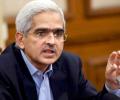
The rising COVID-19 infections across the country are a matter of concern, but it may not impact the ongoing economic revival as one does not foresee lockdowns, Reserve Bank Governor Shaktikanta Das said on Thursday. The economic revival will continue "unabated", Das said, asserting that there is no need for a downward revision of RBI's 10.5 per cent GDP growth forecast for FY22. Speaking at Times Network's India Economic Conclave, Das said, "We have 'insurance' to protect economic revival like a fast-paced vaccination drive, greater ability among people to follow COVID protocols", and one does not see lockdowns as well.

Finance Minister Arun Jaitley said RBI and the government are in continuous dialogue and that relationship will continue.

Two members recommended bringing down the rate by 50 bps in the April policy.

The difference between what the banks play in the US and India is not that of soccer and football but rugby and football. SVB also has a unique character. But when risks are mispriced, the fallout could be very similar, points out Tamal Bandyopadhyay.

The mismatch between industrialists' demand and account holders is because of inflation, Rajan said.

The broader NSE Nifty closed 1.25 points, or 0.01 per cent down at 10,564.05.

Issuing a slew of directions, a bench of Justices S Ravindra Bhat (since retired) and Aravind Kumar asked the central and state governments to pay Rs 30 lakh as compensation to the next of kin of those who die while cleaning sewers.

China's birth rate has been in decline since 2017, despite easing of the 'one-child policy' in order to avert an incoming demographic crisis.

Since last month, the realty (down 23%), auto (down 16%) and finance (down 14%) indices have underperformed the market by falling over 13%, as against 8% decline in the benchmark indices

The wider Nifty hit a low of 10,033.35 before finishing at 10,044.10, down 74.15 points or 0.73 per cent.

Despite the relaxation of the one-child policy in 2016, the number of live births per 1,000 people fell to a record low of 10.48 in 2019, down from 10.94 in 2018.

"The poor will not suffer disproportionately due to bouts of sharp inflation, and the middle class will not see its savings eroded," Raghuram Rajan said.

The bond market expects at least 25 basis points cut in the June 6 policy.

RBI said inflation in the second half of the current fiscal is projected at 2.7-3.2%. It retained its GDP forecast for the current fiscal at 7.4%

The economy is gaining traction with gradual pick up in manufacturing activity and moderation in contraction of services, spurred by comfortable liquidity conditions, an RBI article on Tuesday said. Observing that the retreat of the second wave of coronavirus pandemic has been slow, the RBI in an article on the 'State of Economy' said, the aggregate demand conditions are buoyed by the release of pent-up demand post unlock, while the supply situation is improving with the monsoon catching up to its normal levels and sowing activity gaining pace. "Reaffirming the traction that the economy is gaining, the manufacturing activity is gradually turning around, while contraction in services has moderated.

'Trust your new governor,' Omkar Goswami advises RBI Deputy Governor Viral Acharya. 'Just because he is from the IAS and doesn't carry a PhD from a US university does not make him unsuitable for the task.' 'If anything, Das will pour oil on troubled waters, and save the RBI's reputation.'
Central bank moves to infuse liquidity into bond market to help boost sentiment.
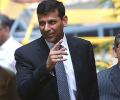
Raghuram Rajan speaks on the unscheduled rate cut.
Instead of a rate hike, or even a pause, there could be a window for the RBI for an interest rate cut

For the first time, the value of card and mobile payments of Rs 10.57 trillion was more than ATM withdrawals of Rs 9.12 trillion in Q4 of fiscal 2019-20. In the months of lockdown, the gap may have widened further, but cash could be back in vogue when the situation normalises.

Finance minister Nirmala Sitharaman on Wednesday exuded confidence that inflation would further decline and the government is on track to meet its budgetary target for deficit and said that there is no fear of stagflation in India. Replying to the debate on first batch of Supplementary Demands for Grants 2022-23 in Lok Sabha, the finance minister said inflation has come down and it is now in the tolerable band of the RBI. Inflation has been declining since April 2022 and it is declining further, she said.
Expressing serious concern over contraction in industrial output in November, India Inc called for immediate policy interventions, including a rate cut by RBI, to prevent job losses and boost demand.

RBI lowered economic growth for the current fiscal to 6.9 per cent from the previously projected 7.1 per cent, but saw it bouncing back in a big way to 7.4 per cent in 2017-18.

Given that there are hundreds of players in the shadow banking space, it's hard to make a credible estimate of potential NPAs. That creates more scope for panic, says Devangshu Datta.

The bank remains on high alert to intervene if markets freeze.

For the week, the battered rupee gained 26 paise against the greenback

The public sector banks are not in a position to cut rates because of their weak balance sheets and massive portfolios of non-performing assets, says Devangshu Datta.
It is thanks to the policy of liberalisation conceived by Manmohan Singh and enforced by P V Narasimha that the Indian economy has now become the world's 5th largest economy by nominal GDP, asserts Dr Sudhir Bisht.

As per the RBI Act, the central bank has to have four deputy governors.
"Kharge dissents regularly," the minister said.
